
How to Search Genesee County Court Records
Michigan runs a statewide case search called MiCOURT, and Genesee County courts feed into it. The public case search covers circuit, district, and probate matters that the courts have marked open to the public. You can look by case number or by a party name. The system also filters by case type, case year, status, judge, and a range of dates. It is free to use.
Before you start, gather what you know. A full name helps. A case number helps more. Older files may not show up at all, because the district court's online records begin on 07/31/2014. For anything before that date, you request the file from Records Processing at 630 S Saginaw St, Flint, MI 48502.
- Open the MiCOURT public case search at micourt.courts.michigan.gov/case-search/.
- Enter a party name or a case number. Name searches match the start of the name.
- Narrow the results by case type, case year, or court status.
- Open a matching case to review its docket rows and hearing dates.
- Request a certified copy from the right records office when you need one for court.
MiCOURT is not the only door. The county's own online services page links to record vendors and portals, and the district court sends users back to MiCOURT while flagging that older files need a direct request. The screenshot below shows that county services hub, which points to public record portals and vendors in one place.
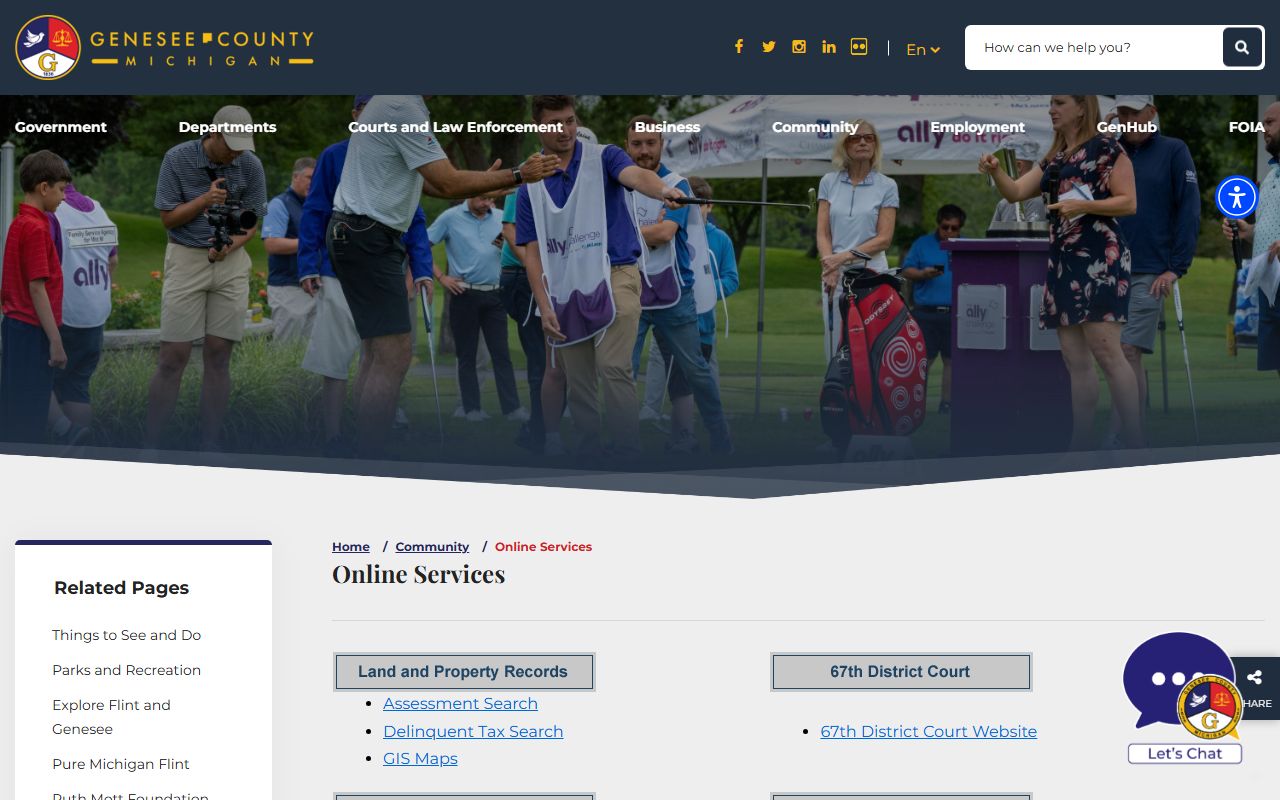
Starting from that hub keeps you from guessing which vendor handles which record. It also shows why a single search box rarely answers every Genesee County court records question on its own.
| Search Field | Type | Required | Notes |
|---|---|---|---|
| Case Number | Text | No | Matches case numbers that contain the value. |
| First Name | Text | No | Participant name begins with this value. |
| Last Name | Text | No | Participant name begins with this value. |
| Case Type Category | Filter | No | Civil, criminal, domestic, probate, traffic, and more. |
| Case Status | Filter | No | Open, closed, disposed, deferred, mediation. |
| Filing Date Range | Filter | No | From and to filing dates. |
| Judge | Filter | No | Searches by the judge's professional number. |
The Genesee County Judicial System
Michigan uses a three-court trial structure, and Genesee County follows it. The 7th Circuit Court is the court of general jurisdiction. It hears felonies, larger civil suits, family cases, and appeals from district court. The 67th District Court is the lower trial court. It handles misdemeanors, traffic, small claims, and landlord-tenant disputes. The Probate Court runs a separate track for estates and protective cases.
Above the county sit two state courts. The Michigan Court of Appeals reviews trial-court rulings, and the Michigan Supreme Court sits at the top. The Michigan Court of Appeals is where most local appeals land first, and its page sets out that role for the whole state.
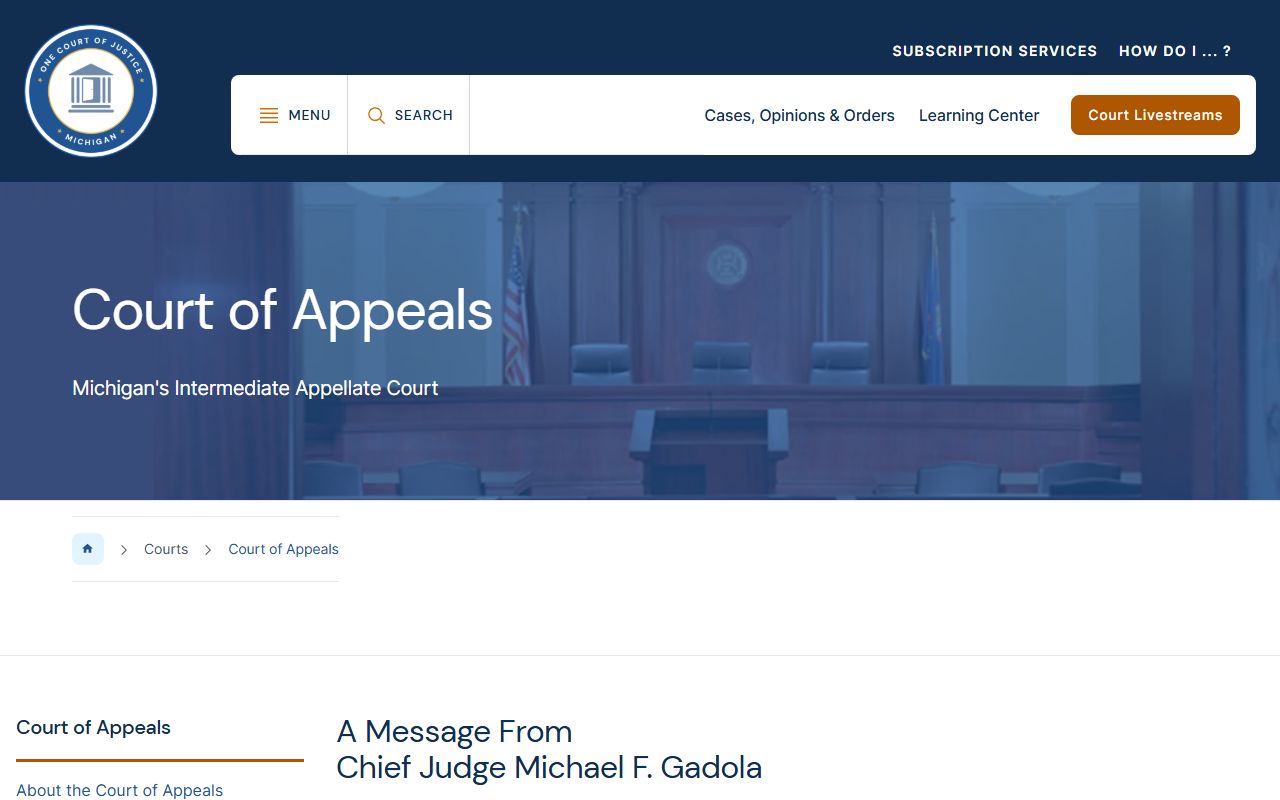
That page confirms the appeal path once a Genesee County case leaves the trial level. Only a fraction of trial rulings ever reach it.
Case flow: District Court › Circuit Court › Michigan Court of Appeals › Michigan Supreme Court. Probate Court runs as a separate track.
| Court | Jurisdiction | Case Types |
|---|---|---|
| Michigan Supreme Court | Highest state court | Final appeals and rule-making |
| Michigan Court of Appeals | Intermediate appeals | Appeals from trial courts |
| 7th Circuit Court | General trial court | Felonies, major civil, family, divorce |
| 67th District Court | Limited trial court | Misdemeanors, traffic, small claims |
| Probate Court | Estate and protective | Wills, guardianship, mental health |
Comparing Genesee County Trial Courts
Readers often send a file to the wrong desk. The three trial courts do not overlap much, so a quick comparison saves a trip. The Circuit Court and District Court split the criminal load by severity. The Probate Court stands apart from both. Match your matter to the court first, then search.
| Point | 7th Circuit Court | 67th District Court | Probate Court |
|---|---|---|---|
| Level | General jurisdiction | Limited jurisdiction | Specialized |
| Criminal | Felonies | Misdemeanors and warrants | None |
| Civil | Large civil and divorce | Small claims and tenant cases | Estates and trusts |
| Example | Felony trial, divorce decree | Traffic ticket, eviction | Guardianship, will |
Family cases such as divorce and custody live in the Circuit Court's family division. Traffic and most low-level crime stay in the district branches. When a death, an estate, or a guardianship is involved, the Probate Court is the right start.
Michigan's own guide to its trial courts explains how these levels fit together across the state. The Michigan trial courts overview is shown below.
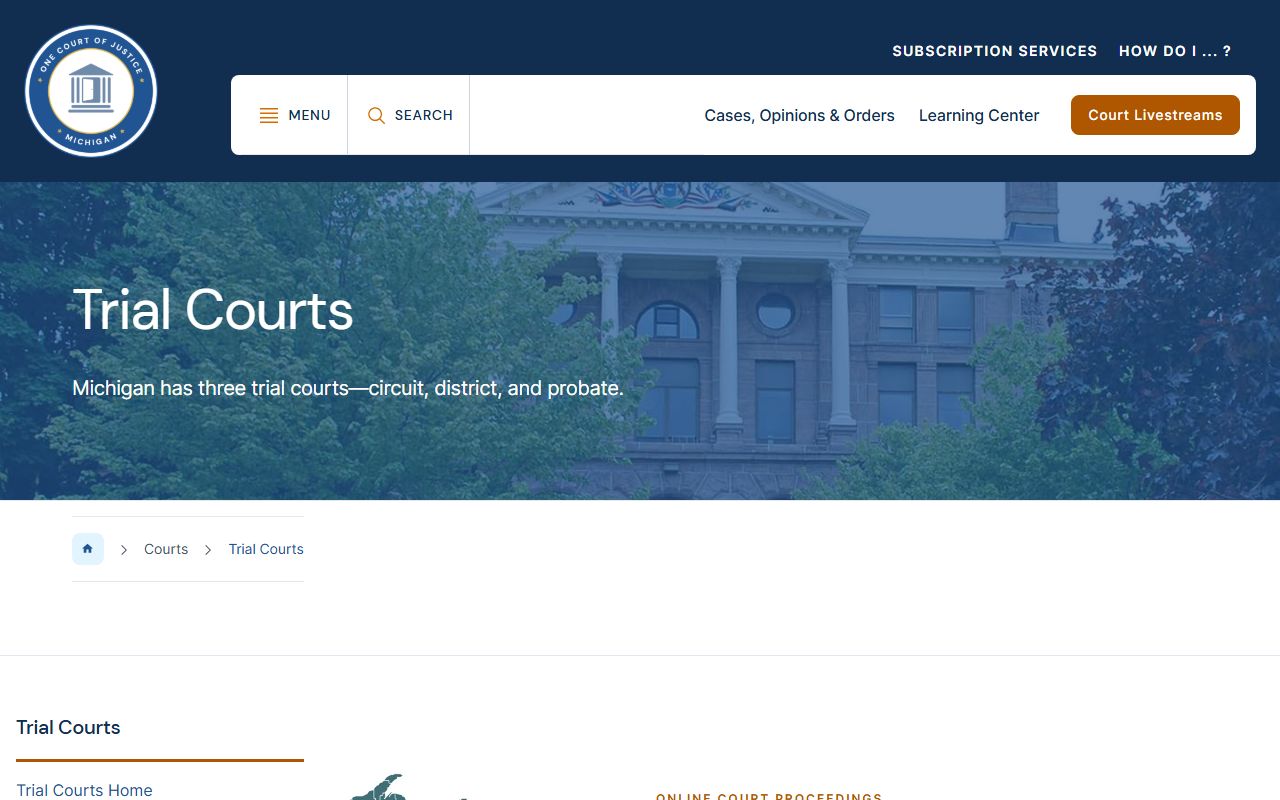
Genesee County's three trial courts each map to a level on that page, which is a quick way to confirm you are aiming a request at the right court.
Genesee County Courthouses
The county's legal offices cluster in downtown Flint along South Saginaw Street. The historic Genesee County Courthouse holds the 7th Circuit Court, and the Probate Court sits on the fifth floor of the same building in Room 502. The County Clerk works from the nearby administration building. The district court spreads across seven branches, from Flint to Grand Blanc. The sheriff's office is a short block south.
The county's courts and law enforcement landing page gathers the court, sheriff, probate, prosecutor, and public defender links in one spot. The image below shows that hub.
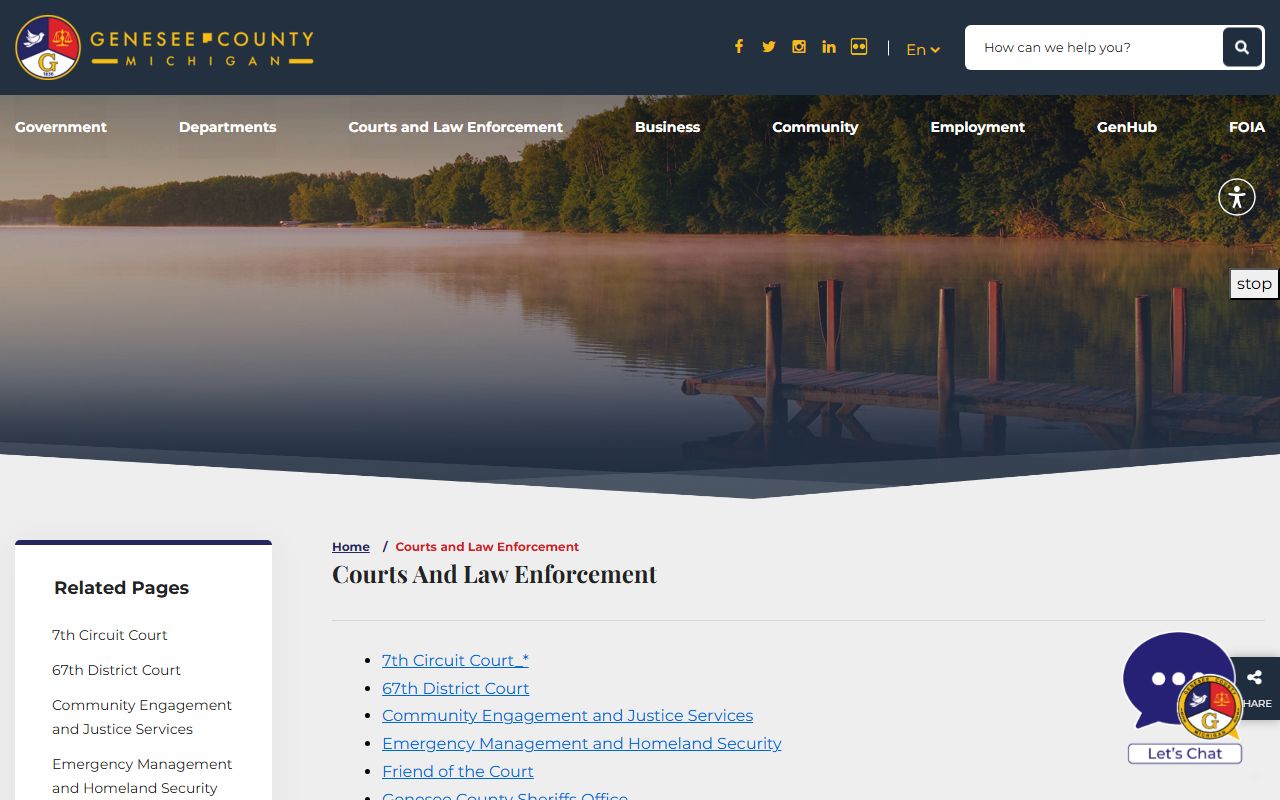
Working from that single page keeps the many Genesee County court offices straight. Each office also runs its own site with contacts, judges, and directions.
Types of Court Records Available in Genesee County
Genesee County produces many record types, and each belongs to a court or office. Criminal and civil files run through the circuit and district courts. Traffic files sit in the district branches. Family, probate, and juvenile records each follow their own rules. Marriage and death records are not court files at all. They are county clerk vital records.
The list below sorts the main categories most readers ask about.
- Criminal records - Felony files in Circuit Court and misdemeanor files in District Court.
- Civil records - Circuit Court suits plus district small claims and landlord-tenant cases.
- Family and divorce records - Divorce, custody, and support in the Circuit Court family division.
- Probate records - Estates, wills, guardianships, conservatorships, and mental-health matters.
- Traffic records - Citations and related docket entries in the district branches.
Juvenile files are handled in the family division and are restricted by law. Michigan's judicial records-management program sets the standards courts follow when they keep and release these files. The page below outlines that framework.
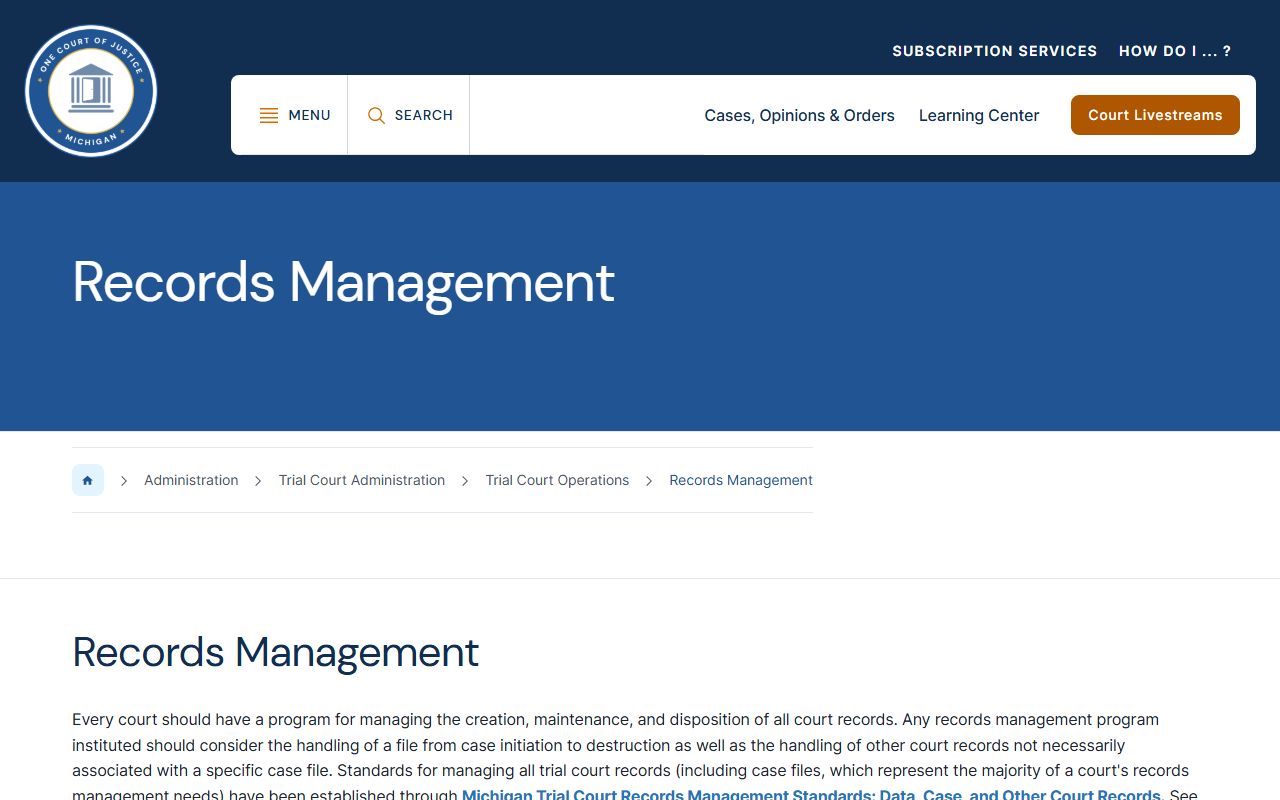
Those standards explain why some Genesee County court records appear online while others stay in a records office. The rules apply statewide, so every county court works from the same playbook.
What Genesee County Court Records Show
A public docket entry gives you the frame of a case, not every page in the file. MiCOURT court displays in Genesee County list the party name, the time, the hearing information, the case number, and the court tracking number. Some rows add attorney and prosecutor abbreviations. Circuit case numbers often carry a year prefix and a type suffix, such as a divorce or criminal tag.
The table below shows the fields a reader can expect to see.
| Field | What It Shows |
|---|---|
| Party Name | The people or entities on the case. |
| Case Number | The court's unique file identifier. |
| CTN | The court tracking number used in displays. |
| Hearing Info | The type of hearing, such as motion or pretrial. |
| Time | The scheduled time for the court event. |
| Location | The court or branch handling the matter. |
Hearing labels tell you where a case stands. You will see terms like motion hearing, final pretrial, non-jury trial, jury trial, and probation violation hearing. A docket shows the event calendar. The full file, with motions and orders, lives with the clerk or the records office.
Public Access Laws for Genesee County Court Records
Michigan starts from open access, then carves out exceptions. The Freedom of Information Act sets the public policy for open government records. Court files answer to court rules on top of that act. Most case files are public at the docket level. Some are sealed or restricted for good reason, such as juvenile or mental-health matters. The statutes below carry the weight.
Key Statutes:
Michigan Compiled Laws § 15.231 - States the public policy that people can inspect government records.
Michigan Compiled Laws § 15.243 - Lists the record types a public body may withhold.
Michigan Court Rule 8.119(H) - The court-record access rule that governs what the clerk releases.
Michigan Compiled Laws § 780.621 - The set-aside law that can clear eligible convictions from public view.
Michigan Compiled Laws § 712A.28 - Limits public access to juvenile court files.
These laws work together. One opens the door, one names the exceptions, and the court rule tells the clerk how to apply both. If a file is not online, the county pages point you to a records desk, a mailing address, or a phone line rather than a dead end.
Records That Are Restricted or Confidential
Not every court file is open. Some are closed by statute, and some by a judge's order. Juvenile records are limited by law. Adoption files are confidential. Mental-health proceedings follow probate confidentiality rules. Sealed and expunged records drop out of normal public search. Personal identifiers, such as Social Security and bank numbers, are redacted from what remains.
A person can sometimes clear an eligible conviction through Michigan's set-aside process. The applicant confirms the record qualifies, files a petition in the circuit court, and serves notice on the prosecutor. A judge then weighs eligibility and the public interest. If the judge grants relief, the record is set aside and pulled from ordinary public visibility. The underlying history may still exist for limited law-enforcement use.
Note: A public search may confirm that a matter exists without showing the document behind it, so a subject of record or an attorney may still need to request the sealed file directly.
Specialty Courts in Genesee County
The 67th District Court runs a sobriety court for people whose cases tie back to alcohol dependence. The goal is steady sobriety and fewer repeat offenses. The program runs four phases over 24 months, and graduation calls for 90 days of documented sobriety. It is a problem-solving court, not a shortcut.
Eligibility is narrow. A participant must show an alcohol use disorder, rate as high-risk and high-needs, be a non-violent offender under the statute, live in Genesee County, and pass a screening interview. The program fee is $300, with probation oversight billed at $35 a month for two years. Judge Jessica J. Hammon presides over the docket.
This model keeps close supervision on participants while they stay in the community. It sits inside the district court system alongside the branch courts that hear ordinary traffic and misdemeanor cases.
Genesee County Sheriff and Jail
Sheriff Christopher R. Swanson leads the Genesee County Sheriff's Office at 1002 South Saginaw Street in Flint. The office runs the county jail, a direct-supervision facility with room for 580 inmates. The corrections division also covers the Flint City Lockup, work detail, tether, and work release. For a custody status, the inmate information line is (810) 257-3426. You can browse the office's services on the Genesee County Sheriff's Office site.
The county does not publish a simple online jail roster. For a county pretrial inmate, the phone line is the first stop. For a sentenced state prisoner, Michigan's OTIS offender search is the statewide lookup. Full booking details, jail contacts, and visitation notes appear on the Genesee County inmate records page, and active warrant channels are covered on the warrant records page.
Marriage, Divorce, and Probate Records
Marriage and divorce records do not sit at the same desk, and that trips people up. Marriage licenses and certificates run through the county clerk's vital records division. Divorce is a circuit court case, searched through MiCOURT or the court records office. Probate matters, such as estates and guardianships, run through the Probate Court's own records office. Each stream has its own fees and forms.
The county clerk's vital records division issues marriage licenses and certified copies. For the full walkthrough, see the marriage and divorce records page and the probate records page. A few probate terms help before you request a file.
- Testator
- The person who made the will.
- Executor
- The person named to carry out the will.
- Conservator
- A person appointed to manage another's finances.
- Intestate
- Dying without a valid will.
Genesee County Court Records Fees
Copy fees change by office. The Probate Court charges by the page. The County Clerk charges a flat fee for the first certified copy of a vital record, then less for extra copies made at the same time. Marriage licenses and assumed-name filings carry their own set fees. The table below pulls the main figures together.
| Item | Amount |
|---|---|
| Probate plain copy, per page | $1.00 |
| Probate certified copy | Add $10.00 |
| Probate archival or microfilm search | $10.00 |
| Clerk certified copy, first | $25.00 |
| Clerk certified copy, each additional | $10.00 |
| Marriage license | $20.00 |
| Assumed name (DBA) filing | $10.00 |
| Will deposited for safekeeping | $25.00 |
Age 65 or older? A person requesting their own birth record pays $5.00. The probate records office can also produce transcripts, but those come through the court recorder line rather than the ordinary copy desk.
How to Interpret Genesee County Court Records
Court files use shorthand, and one word can carry a lot. A charge is not a conviction. A disposition is the outcome. A continuance just moves a date. Reading a docket is easier once the common terms make sense. The short glossary below covers the words that show up most often in Genesee County court records.
- Plaintiff
- The party bringing a civil case.
- Defendant
- The party responding to a case.
- Arraignment
- The first court appearance on a charge.
- Disposition
- The final or current result of a charge or case.
- Bond
- Money or conditions tied to release.
- Bench warrant
- A warrant issued by a judge.
Watch the case number too. A suffix tells you the case type, and a year prefix tells you when it opened. A dismissed charge ends without a conviction. A sealed matter is blocked from public view by order or by law.
Accuracy and Record Limitations
Online records can lag. A hearing result may take time to post, and a public display shows only what the court has marked open. The county's online case search does not merge court dockets with county clerk vital records, and it does not replace the records office for older files. Treat what you find as a starting point, then confirm the detail with the office that owns the record.
Note: Confirm any name, date, or disposition with the originating court office before you rely on an online record for a legal, financial, or personal decision.
History of Genesee County Courts
Genesee County was recognized in 1835, and circuit court has sat on the Flint courthouse square since 1838. That first courthouse opened the same year. The county has built five courthouses over the years since. The current building went up in 1926 and carried murals by Edgar Spier Cameron. A recreated mural was dedicated in 2007, and the building nears its centennial in 2026.
The Probate Court traces its own service to 1836, which gives the county a deep legal record. The courthouse history page tells that story with photos and dates. The screenshot below shows it.
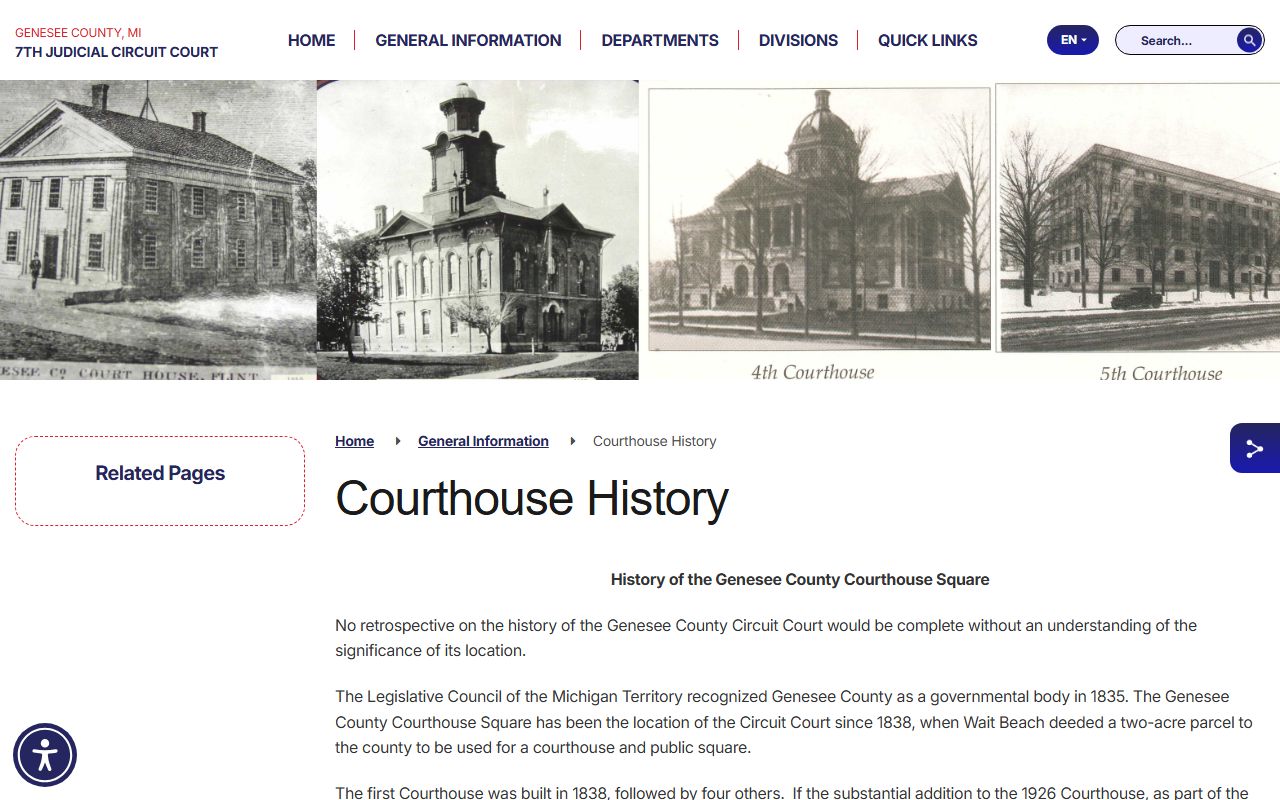
You can read the full account on the courthouse history page. The long lineage is why older records exist at all, even when they are not yet online.
County News and Local Updates
The county homepage runs an active news strip that keeps the site tied to the present, not just the archive. Recent items have covered a Mott Foundation trail commitment, board of commissioners recaps, and county health outreach in downtown Flint. The court and jail side has its own initiatives, from the sheriff's IGNITE reentry program to the GHOST anti-trafficking effort.
The image below shows the county's homepage and news layout.

You can follow current updates on the Genesee County homepage. Those tiles change often, so they are a good gauge of what the county is working on right now.
Frequently Asked Questions
How do I search Genesee County court cases online?
Use the MiCOURT public case search. Enter a party name or a case number, then filter by case type or status. The tool covers circuit, district, and probate cases that the courts have marked public. It is free. Files from before 07/31/2014 in the district court may need a direct request to the records office instead.
Are Genesee County court records public?
Most are. Michigan's Freedom of Information Act and the court rules make case dockets public by default. Some files are sealed or restricted, such as juvenile, adoption, and mental-health matters. Redacted fields hide personal identifiers. A public search may show that a case exists without showing every document inside it.
Where is the Genesee County courthouse?
The historic Genesee County Courthouse is at 900 S. Saginaw St. in downtown Flint, and it holds the 7th Circuit Court. The Probate Court sits on the fifth floor in Room 502. The main court clerk line is 810-257-3220. The district court runs separate branches across the county.
How do I check for a warrant in Genesee County?
The county does not post a full public warrant list. The 67th District Court verifies warrants by phone at 810-766-8968, with walk-in hours on weekday mornings. Call before you go. Bench warrants often appear in district or circuit dockets, and the prosecutor's pre-trial and warrant division authorizes arrest warrants.
How do I find an inmate in the county jail?
Call the sheriff's inmate information line at (810) 257-3426 for county custody status. There is no public online jail roster. For a sentenced state prisoner, use Michigan's OTIS lookup. More detail on booking, contacts, and visitation is on the inmate records page.
Where do I get a marriage license or divorce record?
They come from different offices. The county clerk's vital records division issues marriage licenses and certificates. A divorce is a circuit court case, so its decree is searched through MiCOURT or the circuit court records office. The marriage license fee is $20.00, plus $10.00 if both applicants live out of state.